
Author: Tom Latham
Link to PDF chapterPulmonary complications of transfusion remain the largest category of transfusion-associated mortality. As in previous years, SHOT classifies cases as transfusion-associated circulatory overload (TACO) as per the internationally validated definition (Wiersum-Osselton, et al., 2019), transfusion-related acute lung injury (TRALI) and transfusion-associated dyspnoea (TAD) using international criteria (Vlaar, et al., 2019). Cases which do not meet the TACO reporting definition are presented as a combined ‘non-TACO’ chapter to enable analysis of common features which occur between cases classified as TRALI or TAD.
The trends and themes identified in recent years’ Annual SHOT Reports continue to be apparent.
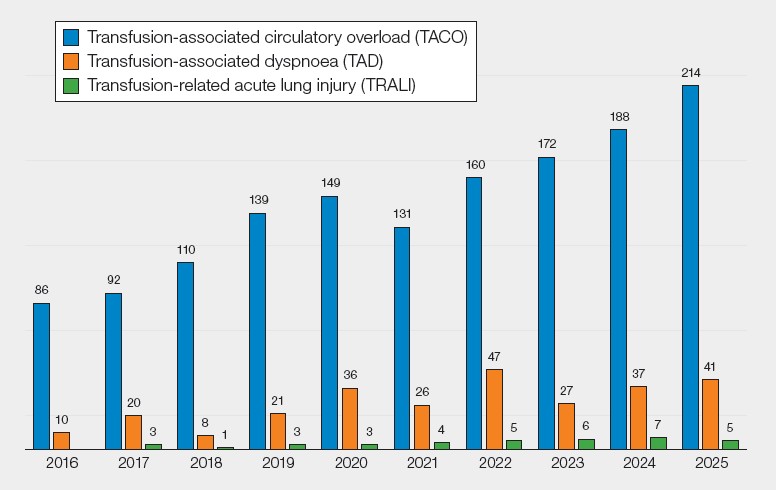
There has been a further increase in reported cases of pulmonary complications reported in 2026,
predominantly due to an increase in TACO cases. Cases meeting TRALI definitions remain rare, with no cases associated with leucocyte antibodies reported in 2025. The non-TACO chapter is dominated by cases classified as TAD, often in patients with substantial comorbidity. Fluid overload was considered to contribute to a substantial proportion of the non-TACO cases even though the cases did not satisfy sufficient criteria to be classified as TACO.
Figure 21.1: Pulmonary complications of transfusion 2016-2025
At the time of writing, it is just over 2 years since the release of the National Patient Safety Alert which
recommended a comprehensive package of TACO prevention measures in England. It is therefore disappointing that there is no signal that this intervention has reduced pulmonary complications so far. Uncertainty remains regarding the extent to which incomplete implementation, ineffectiveness of the recommendations, or increased reporting as a result of improved awareness have contributed. It is nevertheless clear that implementation has been complex, with changes in the TACO pre-transfusion risk assessment being accepted following initial feedback. Accordingly, the plan to audit implementation of the risk assessment is being scheduled for 2027 to allow local implementation and improvement cycles to proceed.
There is indeed genuine uncertainty about the most effective way in practice to identify and manage potential transfusion recipients who are at risk of fluid overload. However, this year’s TACO chapter highlights high levels of transfusion which do not appear to comply with recommended transfusion thresholds. While reducing unnecessary and avoidable transfusion could not in any way be described as an ‘easy win’, this does reinforce the message from previous years that careful consideration of the risk and benefit of transfusion is important, particularly in unwell patients who may have reduced capacity to tolerate transfusion.