Author: Debbi Poles
Link to PDF chapter Link to supplementary informationGlossary, acknowledgments and reference list
Please access these links for the Glossary for all abbreviations, Acknowledgments and References used.
Introduction
The total number of reports submitted to SHOT in 2025 was 5147, a small increase to the number
of reports submitted in 2024 (n=5033). After a dip in 2020 and 2021, likely because of the COVID-19
pandemic, the number of reports submitted has increased steadily year-on-year (Figure 2.1). The number of reports submitted per 1,000 blood components issued is also increasing while the number of blood components issued each year reduces.
Figure 2.1: Haemovigilance reports submitted by year with reports per 1,000 blood
components issued 2010-2025
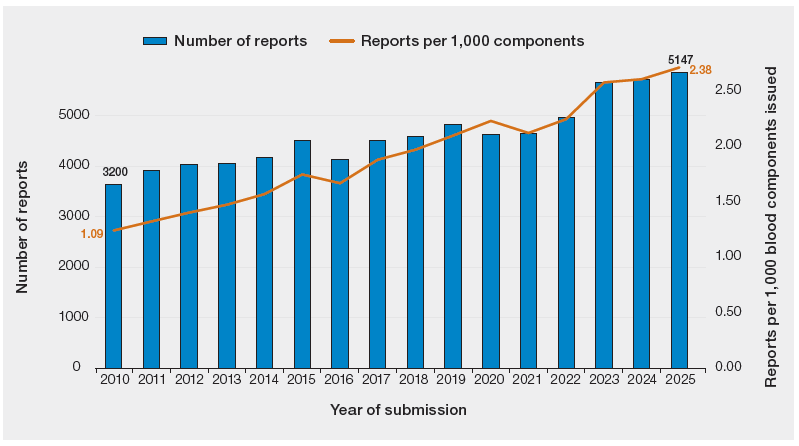
Figure 2.2 shows that there are consistent proportions of the status of reports submitted during each
calendar year at the time of the cut-off date for the reporting year over the last 5 years (i.e. withdrawn, incomplete or complete). On average 72.3% of submitted reports are completed and included in the data analysis for the year they were submitted; 10.4% of reports remain incomplete, and 17.3% are withdrawn by SHOT. Of the reports that are incomplete at the end of the year, these will go on to be either completed and included in subsequent years Annual SHOT Reports or will be withdrawn.
Ideally, most of these incomplete reports should be finalised earlier and therefore included in the correct years data analysis. SHOT would urge reporters to complete their questionnaires as soon as possible after submission so that the data, and safety messages, remain current. Whilst it is accepted that some reports may have lengthy investigations or have been submitted too close to the end of the year to complete, there were 190/538 (35.3%) incomplete reports in 2025 that were submitted during January to October 2025 but were not completed before 30th December 2025.
Learning point
- The SHOT Database Dashboards can be used to identify incomplete reports that still require completion using the ‘Status of SHOT reports’ graph and data export facility (see ‘Recommended resources’ for user documentation).
Figure 2.2: The status of reports submitted to SHOT 2021-2025
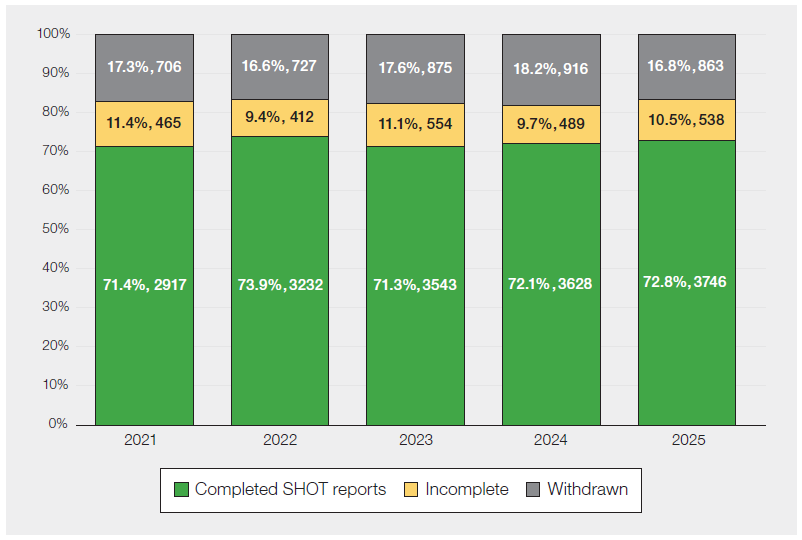
In 2025, 3746/5147 (72.8%) reports were completed by the reporter and have been included in the
2025 Annual SHOT Report. This total includes 3674 SHOT adverse event or reaction reports, 63 anti-D
immunisation reports, 6 ACE reports, and 3 Blood Service reports. There were 863 withdrawn reports,
including Medicines and Healthcare products Regulatory Agency (MHRA)‑reportable‑only cases (some of which the MHRA still includes), mild reactions, and events later found to be unrelated to transfusion; suspected transfusion reactions should be reported ‘as soon as known’ (Department of Health, 2005) and therefore some will be unavoidably reported when they are not in fact related to transfusion; as well as cases not meeting SHOT definitions.
Completion of SHOT reports in 2025
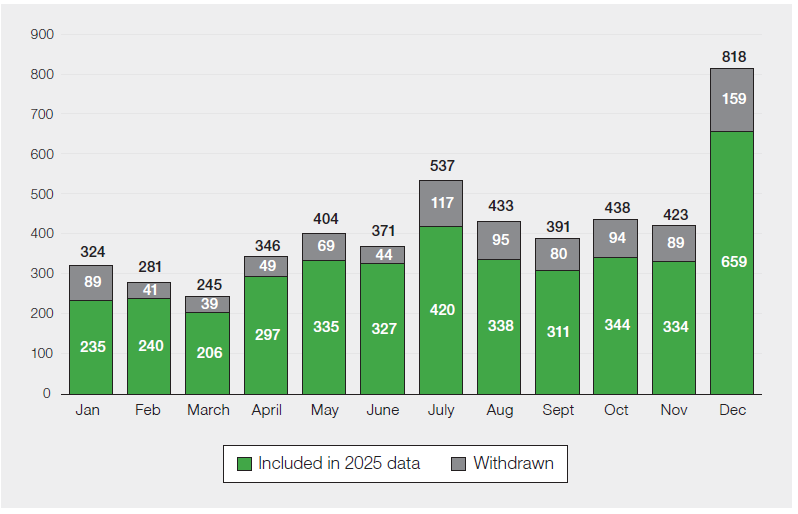
Reports to SHOT are completed and analysed throughout the year, however, there is considerable
variation in the numbers completed each month. Figure 2.3 shows the total number of reports completed within each calendar month, split by the number accepted into the 2025 Annual SHOT Report data, and the number of cases subsequently withdrawn that did not meet the SHOT reporting criteria.
There was a slight drop in numbers completed during February and March 2025, which could be
accounted for by some extended downtime whilst the new MHRA Serious Adverse Blood Reactions
and Events (SABRE) system was being introduced. There was a small spike in July 2025, which could
have been because of the release of the 2024 Annual SHOT Report and SHOT Symposium. However,
the biggest spike by far was in December 2025, with almost double the number of reports being
completed compared to previous months. This is no doubt because there is more focus on getting
reports completed before the end of year deadline.
Figure 2.3: Number of reports completed by month in 2025
Cases included in the 2025 Annual SHOT Report n=4046
The total number of reports analysed and included in the 2025 Annual SHOT Report was 4046. This
total comprises 3674 reports submitted and completed in 2025, plus 372 that were submitted in earlier years, but not finalised until 2025 (this included 362 reports submitted in 2024, 8 in 2023, and 1 each from 2022 and 2021). This is a small increase of 48 from the 3998 reports included in the 2024 Annual SHOT Report (Narayan, et al., 2025).
In addition to these 4046 reports, there were 73 reports of immunisation against the D-antigen. These
are counted separately as part of a stand-alone study. There were also 6 reports included in the ACE
category, as examples of good practice, and 3 SHOT reports from Blood Services.
The number of reports with potential for patient harm (excluding near miss and right blood right patient) was 2381, an increase of 69 from 2024 (n=2312).
Blood component issue data 2025
Table 2.1 lists the total number of blood components issued from the UK Blood Services in 2025, and
the number of solvent-detergent fresh frozen plasma (SD-FFP) (Octaplas®) units issued in each country.
Table 2.1: Blood components and SD-FFP issue data for the calendar year 2025 in the UK
| Red cells | Platelets | FFP | SD-FFP | Cryo | Granulo-cytes | Totals | |
| NHSBT | 1,322,771 | 247,338 | 169,596 | 60,215 | 41,264 | 2,100 | 1,843,284 |
| NIBTS | 41,087 | 8,376 | 4,194 | 2,625 | 1,002 | 0 | 57,284 |
| SNBTS | 134,616 | 22,533 | 12,118 | 3,070 | 3,137 | 68 | 175,542 |
| WBS | 70,971 | 9,114 | 7,191 | 911 | 348 | 0 | 88,568 |
| Totals | 1,569,445 | 287,361 | 193,099 | 66,854 | 45,751 | 2,168 | 2,164,678 |
SNBTS = Scottish National Blood Transfusion Service; WBS = Welsh Blood Service
Cryo=cryoprecipitate; FFP=fresh frozen plasma; SD=solvent-detergent
Cryoprecipitate numbers are expressed as pools and single donations as issued; all other components are adult equivalent doses
SD-FFP data is supplied by Octapharma for England and Scotland; in England, hospitals order directly from Octapharma and in other countries, the process is via the Blood Services
SHOT reporting by UK country
Full tables containing the breakdown of data from 2025 by UK country and previous years can be
found in the supplementary information.
Reporting organisations in 2025
To calculate participation data by reporting organisations, SHOT combine data from individual hospitals into their parent National Health Service (NHS) Trust or Health Board. This is because there are varying reporting arrangements between different organisations. Some NHS Trusts/Health Boards submit from only one reporting account, whereas others may have one reporting account per hospital.
In 2025 there was again only 1 NHS organisation that did not submit any reports. This was a very low
blood user (issued with less than 500 components).
There were 25 non-NHS organisations that submitted 51 reports in 2025 which is a slight decrease
from 2024 (56 reports from 27 non-NHS organisations). This includes healthcare organisations situated in the Channel Islands who are not considered to be a part of the UK and therefore are not regulated by the MHRA.
SHOT participation benchmarking data
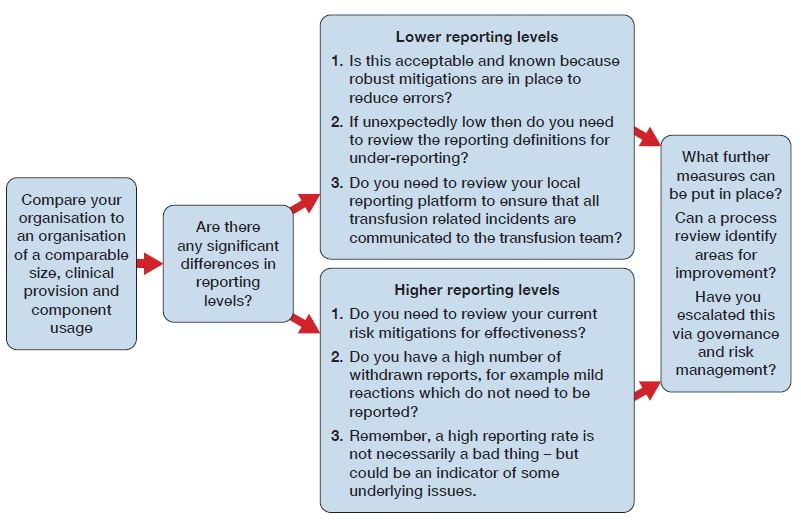
SHOT haemovigilance participation data provides a robust benchmarking tool and is a key component of continuous improvement in healthcare. By measuring activity, comparing performance with organisations of a similar size and clinical profile, and identifying opportunities for tangible improvement, organisations can strengthen patient safety and support effective local governance. Participation data enable teams to explore variations in reporting levels, review the effectiveness of risk mitigations, and identify areas where process review or escalation through governance and risk management may be required.
SHOT participation data are collated and published annually each autumn, with additional monthly
updates that summarise reporting activity by category. While monthly figures may be subject to change following expert review, both annual and monthly datasets should be routinely reviewed by reporters and local governance teams and discussed within local and regional transfusion meetings to help drive service improvement.
Figure 2.4: Using SHOT participation benchmarking data to drive improvements
It is also encouraging to note the findings from the 2025 National Blood Transfusion Committee
(NBTC) National Transfusion Practitioners’ Network survey, which highlight ongoing engagement with haemovigilance and quality improvement. This survey which covered England, received a total of 111 responses; 88% indicated that they were aware of the SHOT participation benchmarking reports produced for each reporting organisation and 69% confirmed that they use these reports locally to monitor participation level and benchmark against organisations with similar transfusion activity (NBTC, 2025a).
SHOT reporting database developments (Dendrite)
Blood Services reporting to SHOT
From August 2025 there have been new questionnaires added to the SHOT reporting database to accept reports from UK Blood Services in selected categories – see Chapter 7, UK Blood Services Reporting.
Reports submitted by Blood Services have always been included in the overall participation data for haemovigilance reporting, but these reports were previously MHRA-reportable only and were automatically withdrawn by SHOT. Most reports from Blood Services relate to issues with blood donation or testing of blood that does not reach the patient’s side, so the new Blood Service reporting categories for SHOT have received relatively few reports. So far, 3 reports from 2025 have been completed for SHOT in the new reporting categories.
Conclusion
Participation in haemovigilance reporting has been consistently increasing, and evolving, with 2025
seeing the introduction of 3 new Blood Service SHOT reporting categories.
However, whilst there are high participation levels, analysis of the data shows that there is room for
improvement with regards to the timeliness of report completion. This would enable a more robust and comprehensive analysis of the data. Some reports are not completed until months or even years after the initial report submission, which complicates the report analysis if important data items are not available and unobtainable given the length of time that has passed. In addition, the fact that so many reports are completed at the end of the year impacts on the ability for these reports to be thoroughly analysed due to the volume being received and the tight timescales for production of the Annual SHOT Report. SHOT encourages reporters to complete reports as soon after submission as feasible, and to contact the SHOT team for advice and assistance if there are any barriers to completion.
Recommended resources
SHOT Database Dashboard User Documentation – July 2025
SHOT Participation Benchmarking Data
SHOT Monthly Participation Data