Definition
Information Technology errors include transfusion adverse events which relate to laboratory information management systems, other IT systems, and related equipment used in the delivery of hospital transfusion services. Cases include events where IT systems may have caused or contributed to reported errors, instances where IT systems were used incorrectly, and instances where hospitals recommended IT-based solutions for corrective or preventive actions in response to these errors.
For further details and examples of what to report, please visit the SHOT Definitions page.
No detailed IT incident analysis was undertaken in 2015; the report focused instead on reviewing recurrent themes and reiterating key messages and recommendations from previous years.
While reported error rates appear to be increasing, this may reflect better identification and reporting of IT‑related issues, alongside improvements in reporting systems and safety culture, rather than reflecting only an increase in IT-related safety events.
IT errors in SHOT Reporting
Since 2006, the Annual SHOT Report has provided a detailed analysis of transfusion adverse events linked to laboratory information management systems (LIMS) and other information technology (IT) systems used within hospital transfusion services. These incidents were originally reported under the Incorrect Blood Component Transfused (IBCT) category. From 2010 onwards, the scope expanded to include IT‑related anti‑D errors. To improve the clarity and focus of reporting, these events were given their own dedicated chapter starting in 2011.
SHOT Transfusion Safety Standards
The SHOT Transfusion Safety Standards were released in July 2025, and these replace recommendations in the Annual SHOT Reports. More details on these can be found at: https://www.shotuk.org/transfusion-safety/transfusion-safety-standards/
Recommendations from recent Annual SHOT Reports (prior to 2024)
- Undertake a gap analysis for all existing transfusion-related IT systems and automation against the updated UKTLC standards (standard 3) (Dowling, et al., 2024) and the updated BSH guidelines for the specification, implementation, and management of IT systems in hospital transfusion laboratories (Staves, et al., 2024). A gap analysis tool has been provided by BSH
- The specification of new IT systems and upgrade of existing systems should be undertaken with
reference to updated BSH guidelines for the specification, implementation, and management of
IT systems in hospital transfusion laboratories (Staves, et al., 2024) - When introducing new IT systems across any part of the transfusion pathway, human factors and ergonomics should be considered to gain all the possible benefits of technology for staff, as well as for patient safety
Action: Laboratory managers, IT professionals, hospital transfusion teams
- All available information technology (IT) systems to support transfusion practice should be
considered and these systems implemented to their full functionality. Electronic blood management systems should be considered in all clinical settings where transfusion takes place. This is no longer an innovative approach to safe transfusion practice, it is the standard that all should aim for.
Action: Hospital Chief Executives, Hospital Risk Managers and Hospital Transfusion Teams
Please see the individual SHOT chapters at the end of the page for other previous recommendations which remain relevant.
IT errors SHOT resources
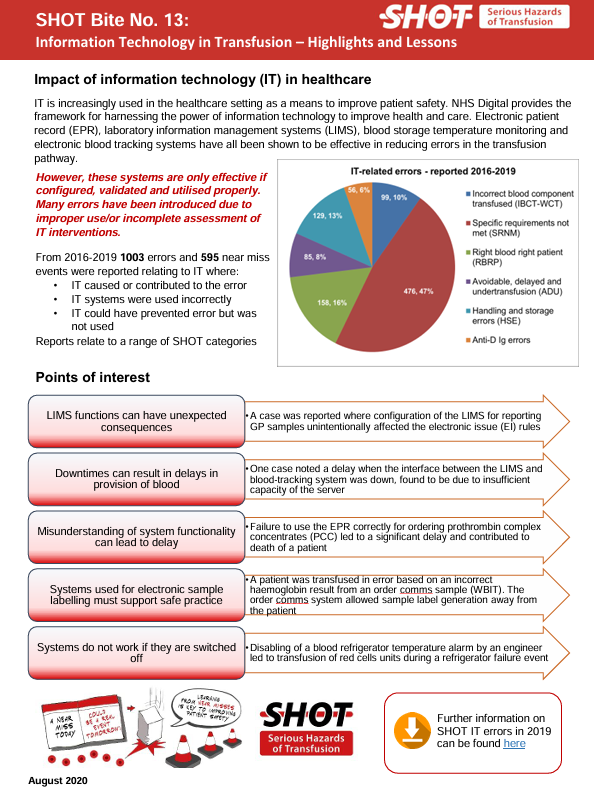
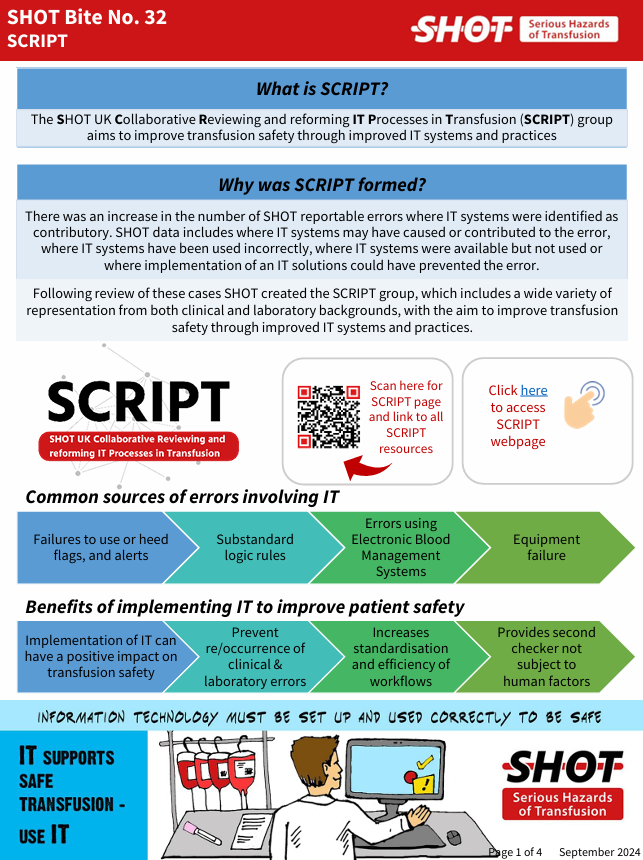
This Meet the Experts session was held on 17th of December 2024. It includes a presentation followed by a Q&A session, and the panellists for this webinar were Dr Megan Rowley (SHOT Steering Group Chair, previous IT Working Expert Group member), Nicola Swarbrick (SHOT Laboratory Incident Specialist, SCRIPT member), and Dr Jen Davies (Transfusion Laboratory Manager at Royal Devon University Healthcare NHS Foundation Trust, SHOT IT Working Expert Group member), and further contributions from the SHOT team.


Other IT Errors resources
IT Errors Annual Report Chapters
To access the chapter click either on the cover of the Annual SHOT Report or the link below the picture.